Transmit DATV on a wire using a Pi
Cool program that allows you to transmit digital DATV (h264 + qpsk + reed-solomon) without an SDR using just a Raspberry Pi and a wire.
- Published
- Length
- 2 min read
- Views
- …
- Tags
- RF
Recently I came across the rpidatv program by F5OEO which promises live digital video using simply the Pi and a piece of wire as the antenna.
As someone who spent the past month researching different SDRs and built my own protocol for sending digital video (i’ll have a post on this soon™️), I was quite skeptical at first. Traditionally, SDRs consist of an FPGA + RFIC that work together to create the necessary modulation. Here, none of that is present. Just a Pi and a GPIO pin being toggled on and off.
The original project is 10 years old, and as such, it did not compile on the latest version of the Raspberry Pi OS. The original project had a lookup-table programmed in assembly (dvbenco8.S) which I rewrote in C so it could be compiled for the Pi 4’s arm64 cpu.
Some of the dependencies are also not available on debian anymore, such as WiringPi, but it can still be compiled from source. Other dependencies had been renamed as well. Lastly, I ditched the original usage of avc2ts in favor of using ffmpeg for conversion, since I could take use of the Pi’s hardware h264 encoder. My modified code can be found on GitHub
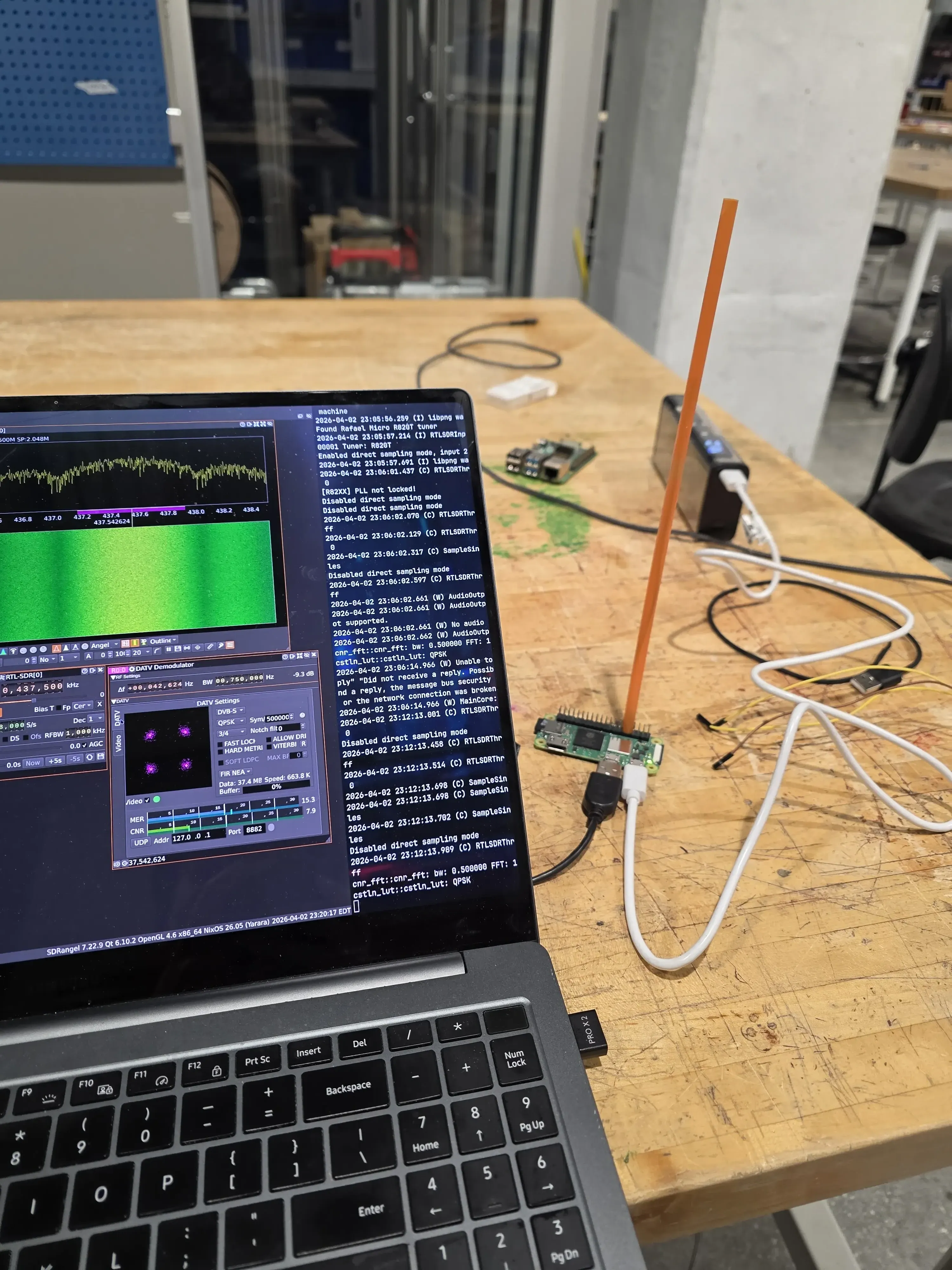
Full system setup. A cut wire is inside the straw which holds it upright. Laptop uses RTL-SDR and SDRAngel to capture and decode the stream
In the end, it worked surprisingly well. I was able to push ~700kbps link with 3/4 fec ratio, which works well to transmit a 640x360 h264 encoded stream. The receiver is an RTL-SDR running a generic V-shaped antenna.
From my understanding of how this works, the signal is generated using PWM via DMA which divides the Pi’s PLL-D (Phase-Locked Loop D). PLLD can run at 500MHz or 1GHz depending on the Pi model, and additional frequencies can be created by dividing this. Higher frequencies can be obtained by using the harmonics created, so with the right fundamental frequency, it can generate a higher frequency. DMA allows for the signal to change rapidly without the CPU having to coordinate everything. But, without a PA or any filters, the resulting signal is weak and bleeds into nearby channels.