DEF CON 34
Attending my first DEF CON; hacking badges, cool talks, and vegas
- Published
- Length
- 15 min read
- Views
- …
- Tags
- cybersecurity defcon
Contents · 7 sections
to summarize my experience at DEF CON 34 in one word: overwhelming.
There was an overwhelming number of talks and events; I would scroll for minutes through the DEF CON schedule app just to realize that I’m still looking at the 10:00 AM talks and haven’t made it forward in time.
I’ve gained an overwhelming amount of information and experience; from my first successful CPU fault injection against a still supported nRF52832 CPU, to my first side-channel attack against an STM32F0 chip, or learning how to bypass certain types of physical locks, and experimenting with a novel SoC made by an individual. Needless to say, there was a lot to ingest in the three days I was at DEF CON.
and most importantly, overwhelmingly fun. Lots of people willing to talk and share their journey. It’s the DEF CON community that makes the whole puzzle fit together.
And just a big thanks to Duke Cyber for sponsoring my trip over!
badges
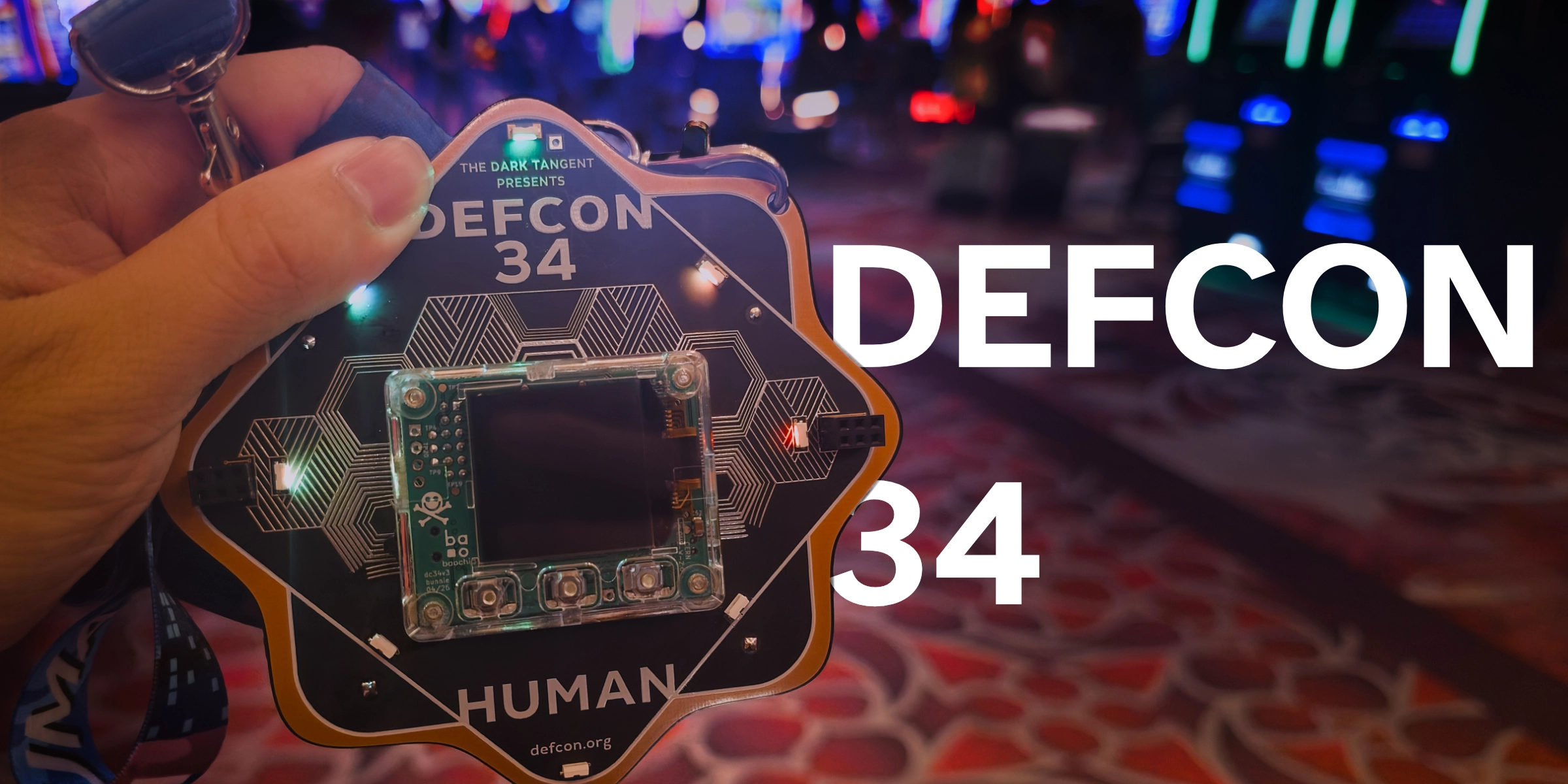
Made by bunnie, this year’s badge contains a fully custom open-source SoC called the Baochip 1x. It’s rocking a solid 350 MHz RISC-V core (based on VexRiscv RV32-IMAC) and 2MiB of SRAM with 4MiB of flash. Aside from being really, really impressive (blows my mind that an individual designed custom silicon!), bao1x is also built with security in mind, so it’s got virtual memory support w/ MMU, hardware crypto-processors, true random number generation, hardware glitch sensors, basically the entire works.
along with the 350 MHz application CPU are four (!) 700 MHz “bao” I/O co-processors. These are also RISC-V based (PicoRV32EC) connected to the main CPU via an array of FIFO queues, DMA, and an event manager. These 700 MHz cores are intended to handle the GPIO pins via the ‘abuse’ of registers r16-31.
Ok, so the hardware is cool, but what does it do? Along with being a hardware key/password manager, the main attraction is the surrounding 8 RGB LEDs. Taking inspiration from nature, the LED colors and animation are derived from a genetic sequence that lives in the chip. You can mix genes with another badge through an encrypted QR exchange protocol using the small camera (GC0308, a 0.3 megapixel VGA cam) built into the badge.
When I saw the badge had an onboard camera, and a small OLED screen, one idea immediately filled my mind. I wanted to turn this into a camera. That night, after the conference, I cloned all the different repos that make up the firmware of the card: dc34-api, dc34-console, dc34-image, dc34-vault, and xous-core, wrote a quick nix devshell, and got to work.
The firmware runs on the xous microkernel which enforces strict boundaries
between services via the bao1x’s MMU and provides an IPC solution for
communication. In the bao-video service, I added an opcode for snapping
pictures. A lot of code from the QR functionality could be reused but cannot be
used entirely as-is. For more reliable QR detection, the QR path applies bit
depth reduction, reducing the monochrome output to strictly white and black. For
a general purpose camera, this loses too much quality, so instead the frame is
stored unprocessed in memory.
if let Some(mut envelope) = snap_request.take() {    let captured = k == '🔥';    if captured {        // stash the full-resolution grayscale before anything else gets        // a chance to overwrite `frame`        last_snap = Some(Box::new(frame));    }    let acquisition = FrameAcquisition {        bits: if captured { frame_to_bitmap(&frame) } else { [0u32; 512] },        captured,    };19 collapsed lines    let mut response = unsafe {        xous_ipc::Buffer::from_memory_message_mut(            envelope.body.memory_message_mut().unwrap(),        )    };    response.replace(acquisition).unwrap();    if orientation == DisplayOrientation::UpsideDown {        display.flip_vertical(true).unwrap_or_else(|_| {            display_timeout_handler(&udma_global, &mut display)        })    }    // remove "frozen" frame    display.clear();    display        .redraw()        .unwrap_or_else(|_| display_timeout_handler(&udma_global, &mut display));
    hal.set_preemption(true);    shutter_consumed_key = true;}
To download the picture, I reused the existing USB serial interface, with a new
command to send the greyscale frame down the wire. Since USB is handled by
another, separate, service, I wired in another opcode in bao-video that will
transfer chunks of data from bao-video’s memory.
GfxOpcode::ReadSnapChunk => {2 collapsed lines
let mut buffer = unsafe { Buffer::from_memory_message_mut(msg.body.memory_message_mut().unwrap()) }; let mut chunk = buffer.to_original::<SnapChunk, _>().unwrap(); let start = chunk.index as usize * SNAP_CHUNK_SIZE; chunk.valid = false; if let Some(snap) = last_snap.as_ref() { if start + SNAP_CHUNK_SIZE <= snap.len() { chunk.data.copy_from_slice(&snap[start..start + SNAP_CHUNK_SIZE]); chunk.valid = true; } } buffer.replace(chunk).unwrap();}Then a simple python script running on my phone via Termux, utilizing the Termux USB API, will pull the photo and store it as a PNG file. I tried using WebUSB for this, but could not get Chrome on Android to detect the badge, but Termux worked perfectly when trying to open the USB serial connection.
Snapping a photo on the badge and viewing it on the OLED.
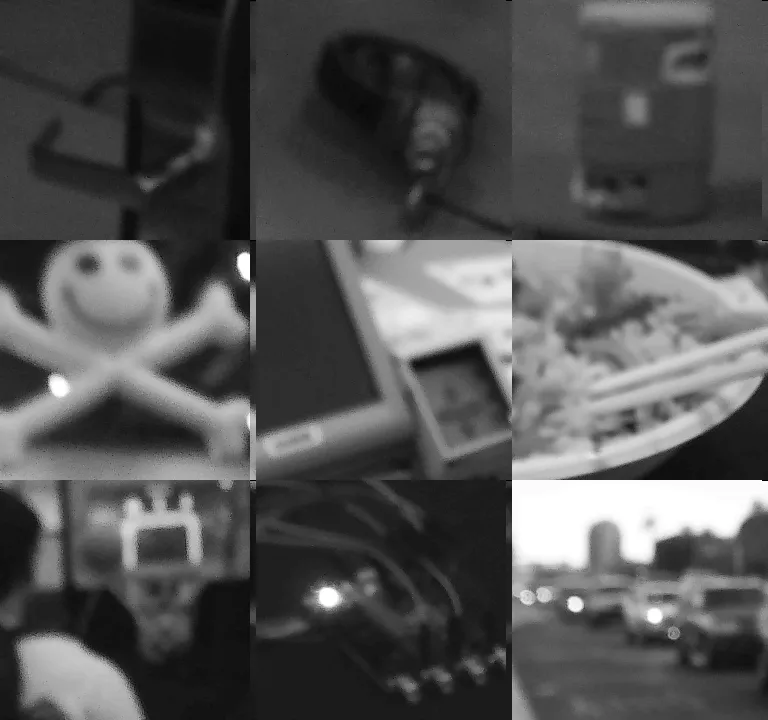
Then, once the con started, I utilized this to take pictures all around the venue. Following the DEF CON photo policy, no pictures of others were taken without permission (not like you can really make them out anyways with this resolution 😅).
Flashing custom firmware has one downside though. For the badge to badge gene exchange mentioned earlier, it relies on a secret key stored in pddb (which you can read more about in bunnie’s blog post). When you upload your own, unsigned, firmware, this key is destroyed and functionality to show your QR and scan others is disabled. Part of the challenge for the badge is to find this key (known as k0) which can be done by collecting enough samples and brute-forcing the rest using a GPU.
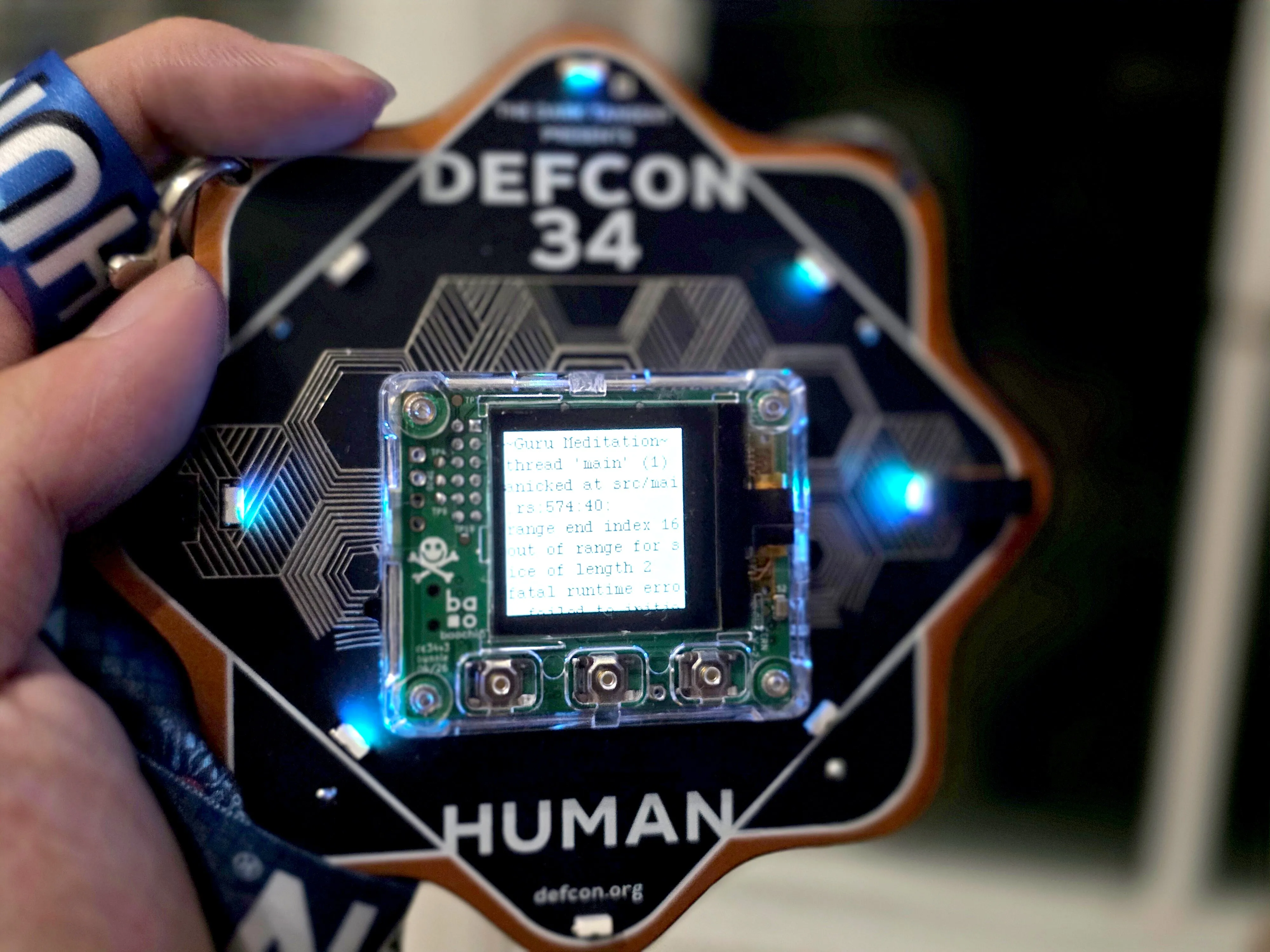
But this unlocks the opportunity for something else. While inspecting the firmware I found this GitHub issue where certain QRs can cause the badge to panic. The original code reads as follows,
match base45::decode(&s.s.as_bytes()) { Ok(data) => { log::debug!("b45dec: {:x?}", data); if data[..DC34_HEADER.len()] == DC34_HEADER { // assume we're scanning their key if data.len() < DC34_HEADER.len() + size_of::<Nonce>() { log::error!("protocol error: key is not long enough");notice that after running base45, data is immediately sliced to
0..DC34_HEADER.len() without any explicit bounds checking! Since Rust is a
memory-safe language, this doesn’t cause undefined behavior, and instead raises
a panic.
As a quick demo, I encoded ‘hi’ into base45 and created a QR code. Scanning it with my badge caused a panic and required a reboot to clear. So, I reprogrammed the UI to add a button that shows this custom QR. Now whenever someone comes to scan my badge, they’re met with a temporary panic.
The keen-eyed among you may have noticed this section is titled “badges” plural. During the con, I picked up another badge at the cryptocurrency village. The company Solana was handing these out for free, and they contain an ESP32-S3, 320x240 touchscreen, dual mics, 1000mAh battery, some buttons, and the SE050 secure element.
The OEM firmware was pretty boring, just a test screen showing all the different sensors. So, the obvious next step is to port DOOM. ESP-IDF has built-in support for the ST7789-based display, so getting video was quite simple. Wired that up to doomgeneric and within no time I got DOOM running on the thing.
villages
At DEF CON, villages are like smaller, more focused, communities. Alongside the previously mentioned crypto village there was the embedded village, maker village, aerospace village, physical security village, and much more. Each village holds their own talks and events.
voltage glitching
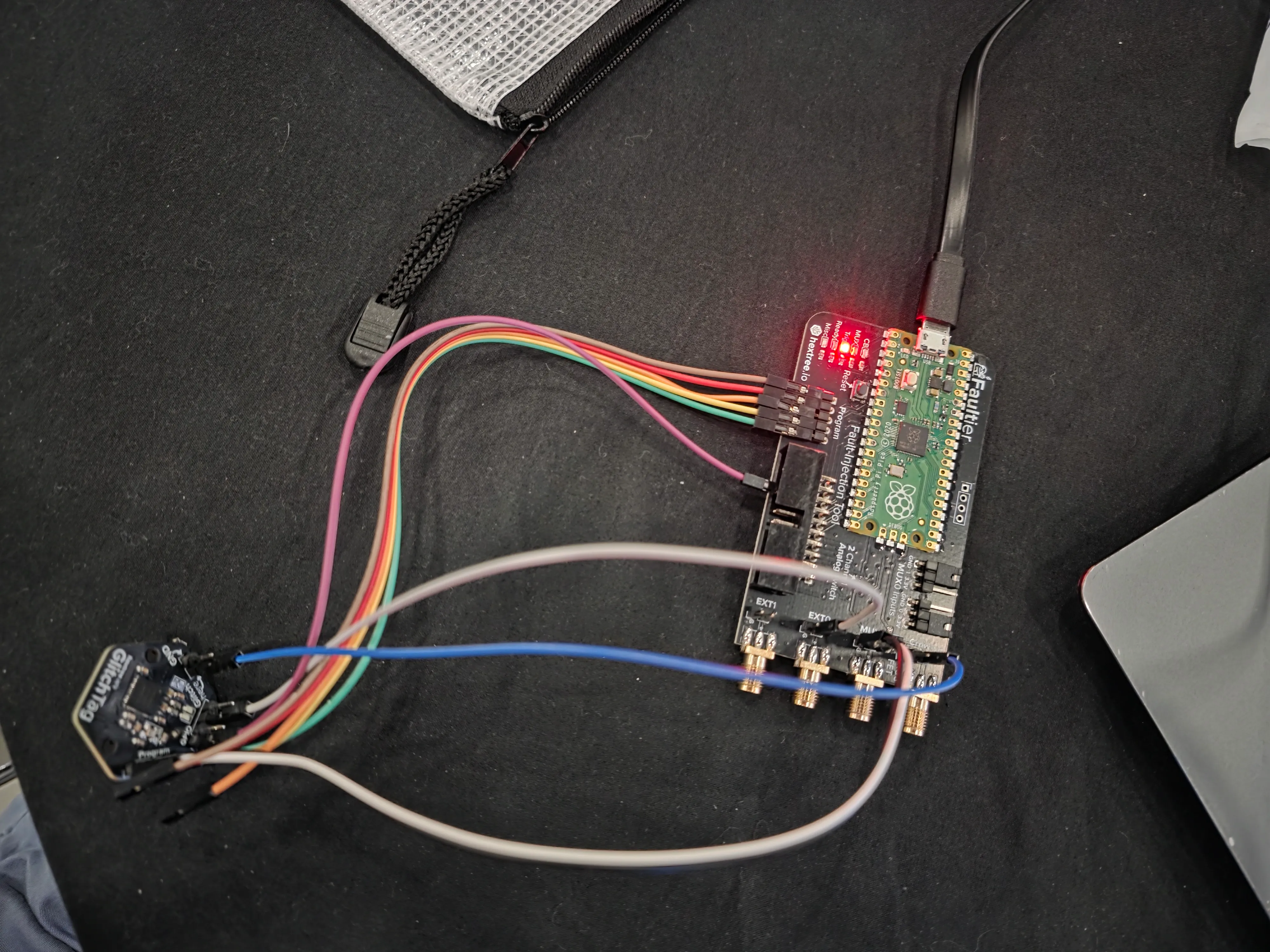
The first village I really sat down at was the embedded village. There, they were lending out a glitching kit to those who wanted to learn. Intrigued, I picked one up. The kit contained an RP2040-based board with a simple FET to turn on and off power to a target board. The target was an nRF52832, the same SoC that powers the Apple AirTags. The goal was to replicate the attack done on Apple AirTags that allows you to dump the firmware of the nRF52832 even when “APPROTECT” is enabled, bypassing the restriction that typically exists.
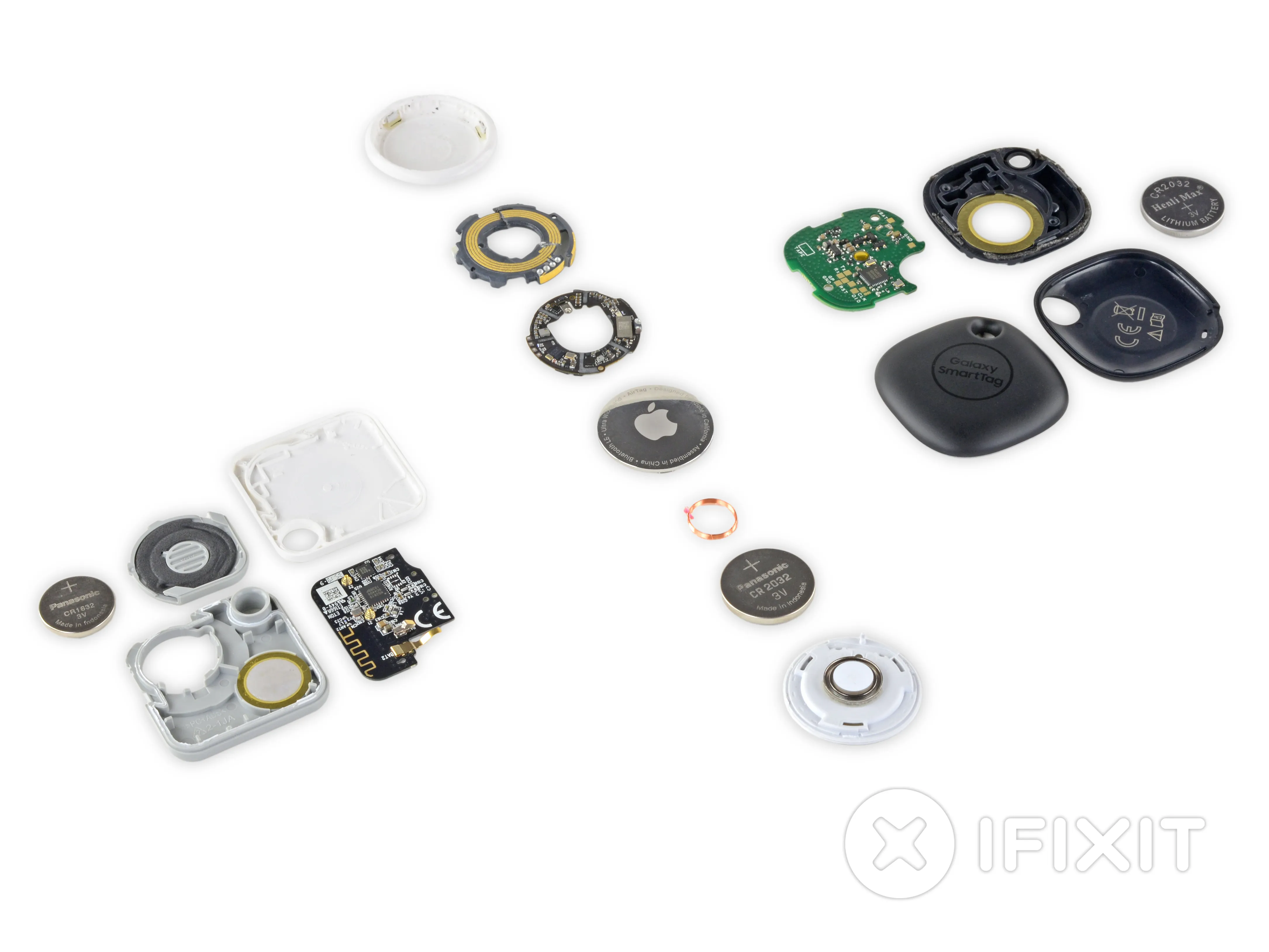
The RP2040’s PIO state machines execute at per-clock cycle level of precision. And the nRF52832 has a correlation between the current draw and the boot process. So by fault injecting the chip at the perfect moment, the chip will skip the APPROTECT check and allow SWD connections, thus allowing you to dump firmware.
Initially, I thought that it would be as simple as dipping the voltage on VCC to the chip, but I quickly found that this is not the case. Like many chips, the nRF52832 uses internal regulators to step down the 3.3V for the main processor, and dropping VCC will affect other parts of the chip as well, like the RADIO peripheral. The solution is to target only the processor by taking advantage of the chip’s external decoupling capacitors.
Having built around the nRF52840, the brother to the 32, I was aware that these capacitors were used to smooth voltage coming out of the internal regulators for the different parts of the chip. Specifically DEC1 was used for the main CPU. So by hooking that up to a FET connected to ground, you can short the main application core down to 0V.
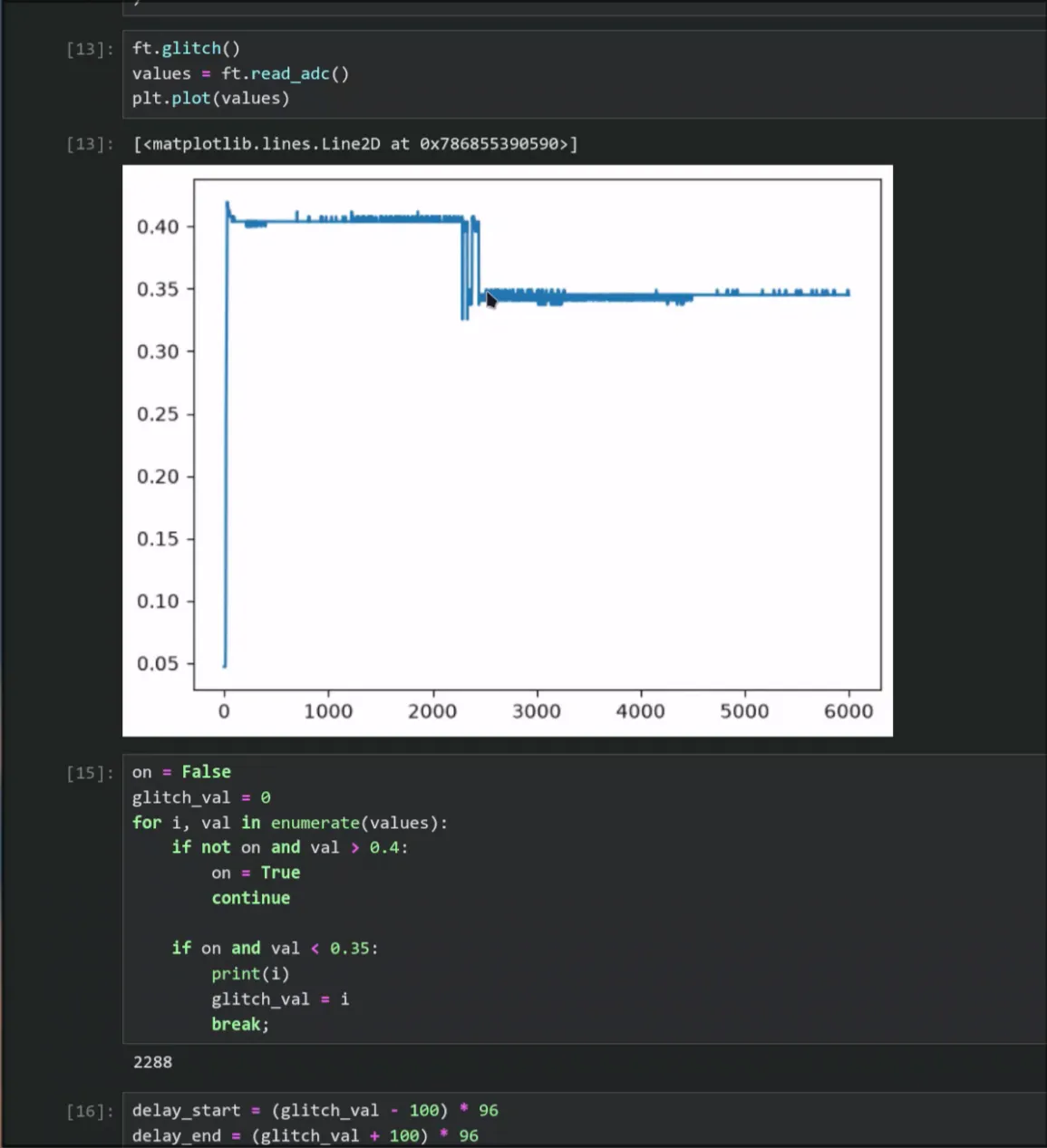
I used a python notebook to graph the boot voltage, then used a stochastic technique to find the perfect injection time. This highly advanced and sophisticated method involved generating two random numbers and praying it works. Yeahh, it was a matter of chance if the glitch would work or not since silicon isn’t perfect and there exist per-chip variations.
In the end though, I was able to retrieve the flag from the firmware, completing the challenge. I also got to speak with the YouTuber LiveOverflow where I asked him questions about modern-day fault injections and how chip designers try and defend against such attacks. He explained how chips have in-built monitors that will reset the chip if an unexpected voltage dip is detected. He described how other attack vectors include EMI fault injection, where you try to induce a current via electromagnetic waves to flip a bit in the chip or cause other malfunctions. It was a great discussion and something I hope to experiment more with in the future.
side-channels
Over at the crypto village, they held a workshop on side channel attacks. This is conceptually similar to the fault injections I just did but instead of trying to get the chip to do something in your favor, the goal is to extract information from variables like the chip’s current etc. To demonstrate, they handed out small boards called the ChipWhisperer Nano. It’s a small STM32F0-based board with an 8-bit ADC capable of 20M samples/sec.
Though it was at this point the WiFi at DEF CON was starting to really slow down, so after spending an hour trying to get the environment set up, I decided to defer the experimentation to later.
cuffed? no problem
At the physical security village, they had many demo stations to teach about… well… physical security.
Ever seen those grocery store carts that lock up if you bring them out of range from the store’s perimeter? Well the way those work is through a simple signal generated by a wire that surrounds the perimeter. This signal lives in the kHz range and is something a simple phone speaker could replicate. By playing a certain frequency tone on my phone’s speaker, I was able to freely lock and unlock these carts!
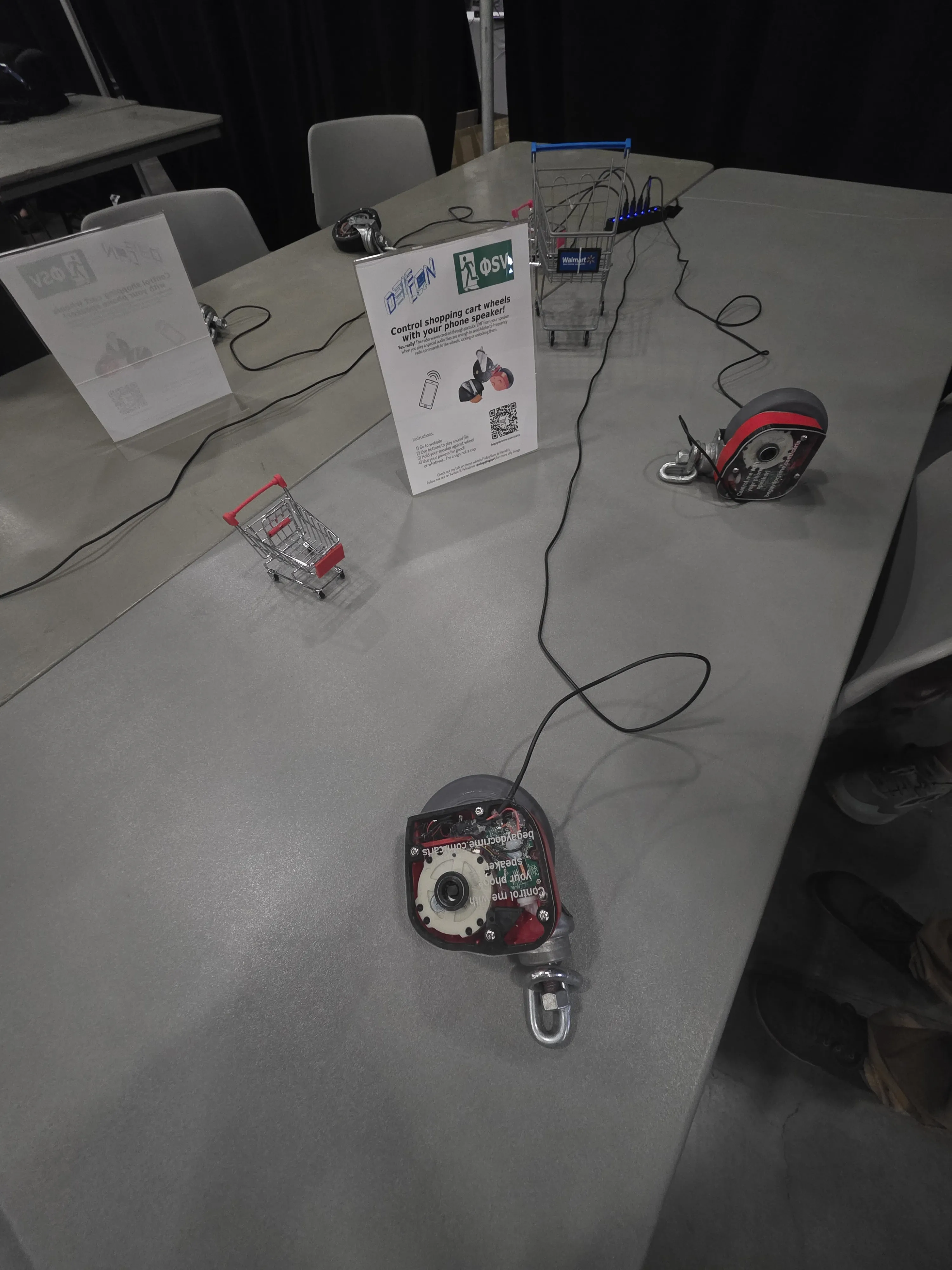
On the more physical side, I learned how to escape handcuffs using a bobby pin, and how to enter locked buildings using rudimentary metal tools. It’s mindblowing how it’s not illegal to teach these skills, but hey, I’m not complaining.
n much much more
these are just a few of the many villages I saw, with some leaning more towards the policy side rather than electrical. There’s honestly too much to write about in one blog post, but I’d like to give an honorary mention to the voting village, specifically Philip, who spent years investigating voting fraud and provided really great evidence on how election security is something that we should care about. You can check out part of his talk on YouTube.
talks
no matter who you are, DEF CON will have a talk you are interested in. They range from surface/beginner level to deep dives on complex topics. The talks also vary greatly in quality too, but definitely lean towards the higher quality side of the spectrum.
For example, one of the talks I watched was about a bug in the Linux kernel’s handling of USB UVC, where an out-of-bounds write could lead to LPE/code execution. This talk was one I definitely had to lock in to understand, where zoning out for one second meant you missed some key information that derailed the rest of the talk. It was highly technical, going into how device descriptors etc worked, and showing off snippets of kernel code that made the attack possible. The presenters have published a paper on this attack if you’re interested.

On the other side of the spectrum was a talk about “hacking” Amazon delivery lockers. The talk was super engaging; it’s an event where “you had to be there” to understand. From a technical standpoint, it’s not the most impressive attack out there. There wasn’t some exploited Bluetooth attack, or some malicious API calls involved, instead it relied on OSINT to find leaked Chinese videos on locker maintenance and social engineering to get lock manufacturers to manufacture a copy of the key based on a still from the videos. This talk was more about the journey rather than the end product, but the speaker shared this journey in such an engaging way that made it one of the highlights of my time at DEF CON.
Lastly, there are still some talks that felt akin to ‘ai slop,’ where you can tell the slides were AI generated (or at least heavily AI-assisted) and the contents included “i let claude work overnight and i got this” a few times. But regardless, there’s so many talks that such variance is expected, and these were like outliers. It did not take away from the overall experience of the con.
party life
I didn’t go to any DEF CON parties.
vegas
Las Vegas is
- hot, reaching upwards of 47°C!
- expensive, bottled water did not come with my hotel room and costs $5-7 in most stores, and a single monorail ticket is $5.50.
- has mid-at-best public transport, the monorail is quite a walk away from the hotel and the conference, and is generally slower than any other public transport system I’ve used.
and honestly, the entire city feels so dystopian, but not because it’s futuristic. It’s built in the middle of a hostile desert and runs entirely off of the money made from people gambling. Everything is engineered to make you want to gamble, as going anywhere means walking through 5 casinos, out in the near 50°C weather, and past 500 slot machines.
Though I’m not trying to fully hate on Vegas, it really is an interesting city, unlike any other city I’ve been to. No other place lets you visit New York New York, Paris, Rome, Egypt, and Venice all in one day. The Vegas identity is built on larping as other cities but adding in a casino, a bar, and a club.
Food is alright, but the experience is 🤌. I got to eat dinner inside a rainforest filled with life-sized animatronics and flashing lights + sound that emulated the feeling of being in a thunderstorm.

takeaways
I’ll end it with a quick rose bud thorn, in reverse:
Thorn: the AI frontier is eating everything up, I saw videos of people competing in DEF CON CTFs by just spawning an agent per challenge all in parallel. It has become a battle of token usage and model harnesses. This applies less to the big, official DEF CON CTF challenges as that requires you to pre-qualify to play, but for smaller comps I saw clips of people completely sitting laid back while agents were whirring away. IMO, this goes against the spirit of the competition. If you cannot explain how you solved a challenge without asking Claude to summarize, is participation even useful? It’s like racing horses against humans, something that should be separated or at least regulated.
i talked to a lot of people who played the defcon ctf finals to understand how llms affected them, both professionally and mentally.
i went in hoping to learn that human intuition still mattered. instead, ctfs in their current form as everyone saying is dead, players are forced…— s1r1us in sf 🌉 (@S1r1u5_)
August 12, 2026
Bud: I cannot wait to attend again. I saw someone wearing a 3D Printer as a backpack, saw many cool badge addons, and generally so many cool projects that I feel inspired to come again next year with something of my own to share.
Rose: I bet you can tell from the rest of this article, but I had such a great time. Tons of engaging, deep talks and plenty of hands-on experience that’s hard to get on your own. It’s stuff I’ve heard floating around but never got to experience until now. At DEF CON, you’re surrounded by people who share similar interests, but live in different niches, creating opportunities to both share ideas and open the door to many interesting conversations.
bonus content: loot haul
All the loot I got from DEF CON. A lot of free stickers and small devboards.
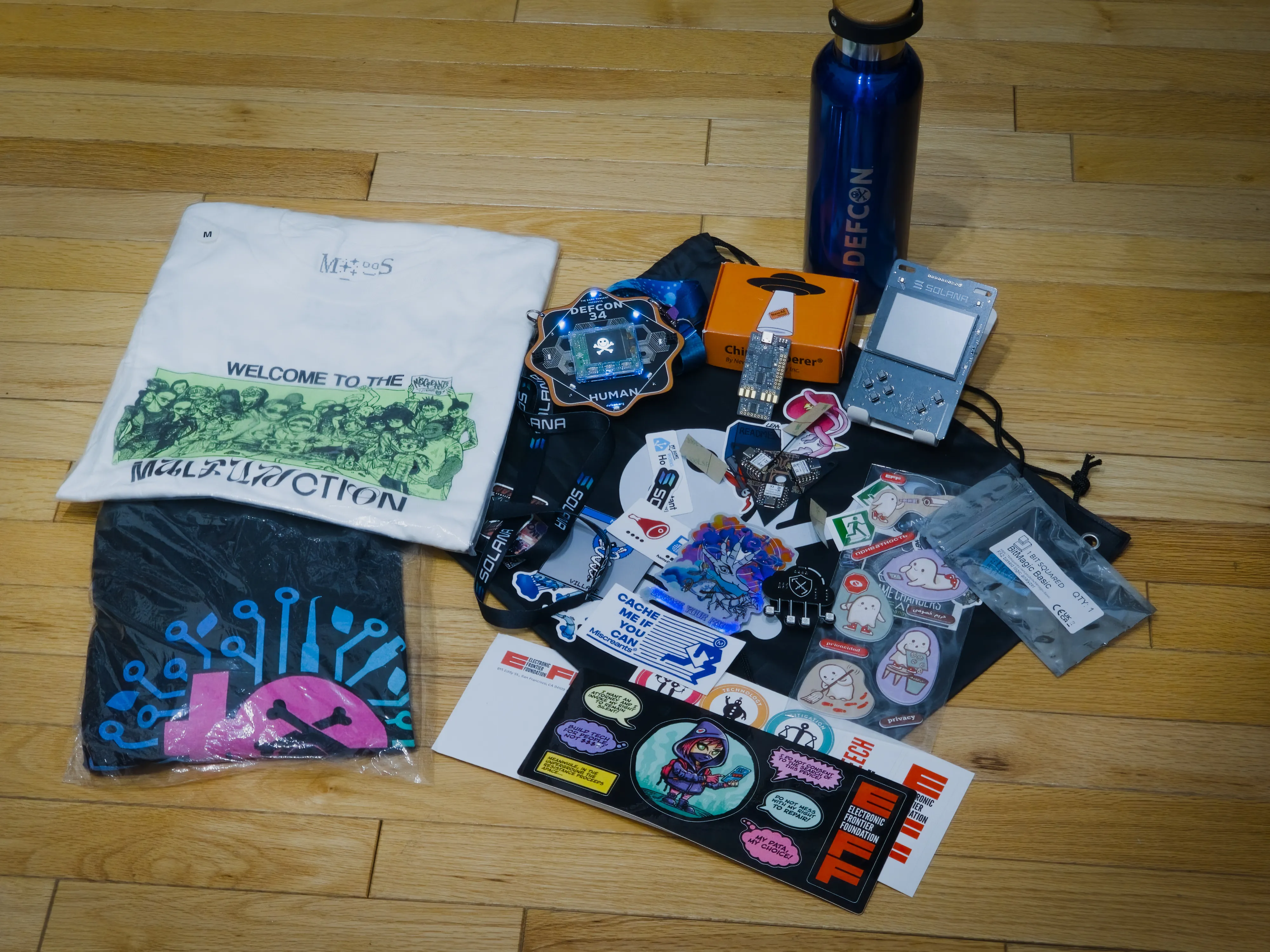
in no particular order:
- Miscreants t-shirt
- DEF CON 34 hoodie
- DEF CON 34 badge
- DEF CON water bottle
- ChipWhisperer Nano
- Solana badge
- 1BitSquared BitMagic Basic
- Badge from Game Changers AI org
- Cloud Village SAO (badge addon)
- Misc stickers from Electronic Frontier Foundation, Miscreants, Nix Vegas Community, AppSec Village, Radio Village, and other villages and sticker exchange areas.